
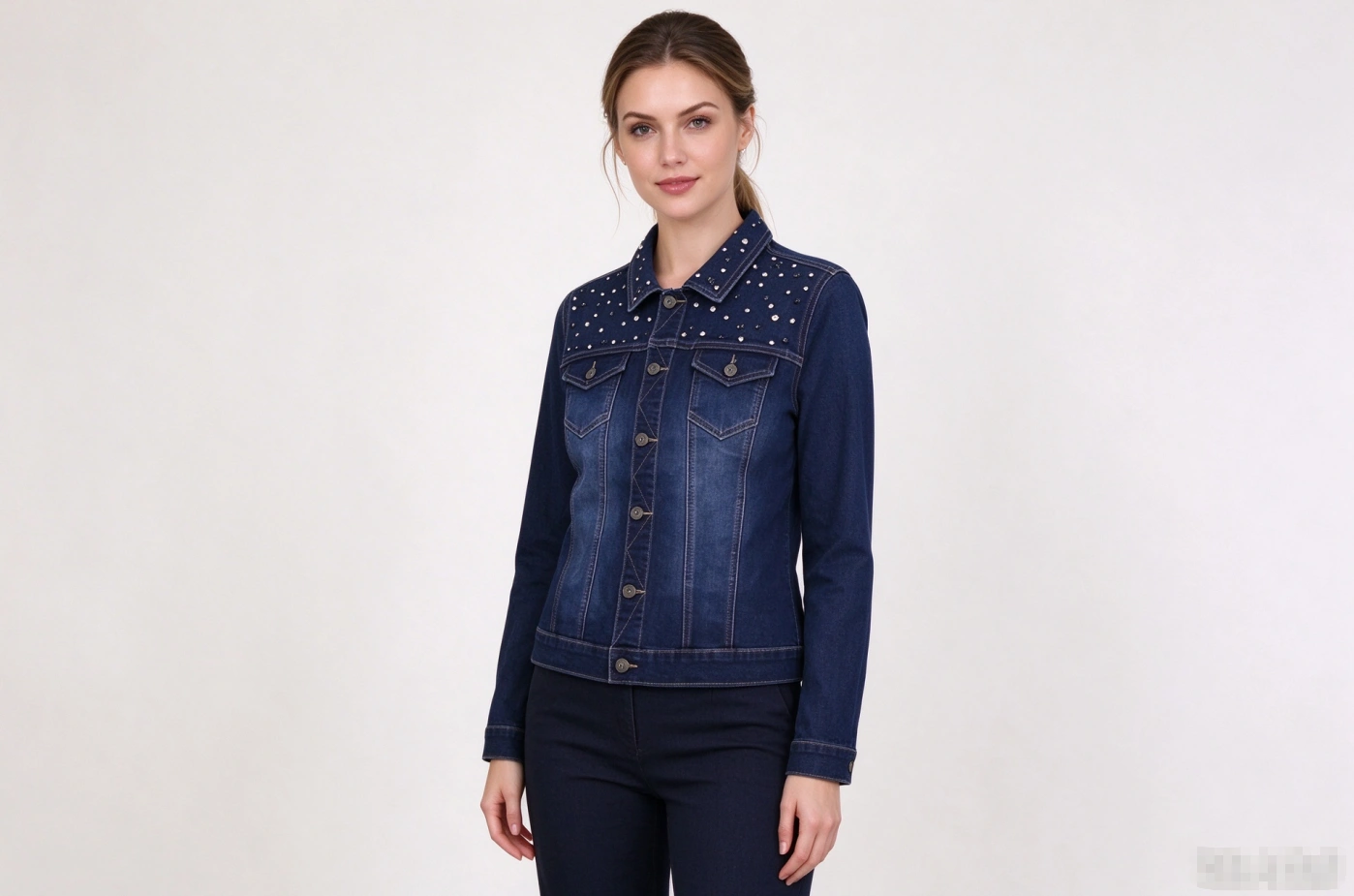
Women's Rhinestone Denim Jacket
Sparkling Rhinestone Denim Jacket for Women Rhinestone Yoke & Dressy Deep Blue Denim Jacket
View productMost buyers start with a category grid and only later work out which details decide a reorder. This index treats the Men's Distressed Biker Jeans as a pattern rather than a single SKU: it maps the fit, the wash depth, the distress intensity, the size curve and the grading rules that sit behind a wholesale jeans mens range, and it shows the point where a mens jeans wholesale programme usually locks in — at sample stage, before the cut order.


The deep blue base carries the fade; contrast topstitching and pale frayed patch edges do the merchandising work on the shelf.
These are the published figures for the pattern this index is built around. Every downstream decision — size curve, reorder quantity, sample brief — is anchored to this table.
| Style | Slim Moto Biker |
|---|---|
| Sizes | 28, 30, 32, 34, 36, 38, 40 |
| Colour | Deep Blue |
| Fabric | 70% Cotton, 28% Polyester, 2% Spandex |
| Features | Big destroyed patches, ribbed panels, stretch |
| Closure | Button fly |
| Pockets | Five-pocket build with back patch pockets |
| Stitching | Contrast topstitching |
| Minimum order | 50 pieces |
The cut is narrow through the thigh and tapers from the knee to a leg opening that sits cleanly over footwear — close without being skin-tight. That single sentence decides three things for a buyer: who the jean suits, how it photographs, and how the size curve should lean.

Treat wash and distress as two separate dials, because they sell differently. Wash depth decides what the jean pairs with on the shop floor; distress intensity decides how loud it reads in a window display.
| Dial | Where this pair sits | Buying consequence |
|---|---|---|
| Wash depth | Dark indigo base with the fade worked through the thigh | Dark enough to match black, white, grey or camel tops and to pass as a dressed-up pair with a jacket |
| Rip-edge tone | Edges lift to a pale grey-blue | Contrast reads at distance, so the piece works as a window or end-cap item |
| Distress intensity | Heavy — big destroyed patches across knee and upper thigh | Statement slot in a buy; balance with plainer pairs if your customer base is conservative |
| Patch finish | Cut, frayed and washed so edges finish as a soft pale fringe rather than a scissor line | The fringe stops the rip travelling further, which protects the return rate on a heavy-distress style |
If your range needs a lighter wash, an acid treatment or a black base alongside this deep blue, put that on the brief rather than assuming it sits on the same pattern — colourways beyond Deep Blue should be confirmed directly with the supplier before you commit shelf space.

The minimum order is 50 pieces, which suits small batch denim production — so the first real decision is not how many styles, but how those 50 units split across seven waist sizes. The chart below is a working distribution weighted toward the middle of the range, where most men's denim volume sits.
| Size | Body waist | 50-piece buy | 100-piece buy |
|---|---|---|---|
| 28 | 71 cm | 5 | 10 |
| 30 | 76 cm | 7 | 14 |
| 32 | 81 cm | 9 | 18 |
| 34 | 86 cm | 10 | 20 |
| 36 | 91 cm | 8 | 16 |
| 38 | 97 cm | 7 | 14 |
| 40 | 102 cm | 4 | 8 |
Totals: 50 and 100 pieces. Adjust the tails to your own sell-through; the shape of the curve, not the exact numbers, is the point.

The waist column is a body waist measurement, not the flat garment — the single most common reason a first bulk order misses at retail. Sizes step in roughly 2 in / 5 cm increments and the stretch waistband gives slightly when worn, then settles back to shape.

A narrow biker cut only works if the cloth behaves. Each fibre in the blend carries one job, and that job is what you are really buying when you reorder.
Read together, that blend is the reason a heavy-distress statement pair can still be sold as an everyday jean — the merchandising claim and the fabric claim have to match, or the reorder never happens.
Match your shelf to the specification before you build the order. Each row pairs a real buying situation with the exact product fact that drives the decision.
| Buyer scenario | Specification that decides it | What to do |
|---|---|---|
| Streetwear shop needing a window piece | Heavy destroyed patches across knee and upper thigh, scaled to read from across the floor | Buy it as the statement slot and lean the curve toward 30–36 |
| Denim bar building a dark anchor | Deep blue wash that passes as dressed-up with a jacket | Hold it as the dark end of the wall; confirm any lighter colourways separately |
| Conservative or workwear-leaning customer base | Rip level is open to your brief at sample stage | Specify a lower rip level rather than dropping the pattern |
| Online-only store with high return risk | Body waist measurement in 2 in / 5 cm steps, thigh tightest point | Publish the waist chart and the "go up one size on a fuller thigh" note |
| Private label starter label | 50-piece minimum; hardware, branding and rip level per your brief | Lock grading and branding at sample stage — not after the cut order |
| Multi-season repeat buyer | Rip and panel placement held on a fixed pattern, not cut freehand | Reorder without re-approving placement pair by pair |

Heavy distress is a maintenance item. Passing these notes on to your customer — or printing them on a hangtag — protects the frayed patch edges and keeps the ribbed panels flat.
The minimum order is 50 pieces and the pattern takes hardware, branding and rip level from your brief. Send your target sizes, your preferred distress level and your label details, and confirm grading against your own size spec before the cut order goes in.
Keep adjacent product options together for a faster catalog comparison.
Sparkling Rhinestone Denim Jacket for Women Rhinestone Yoke & Dressy Deep Blue Denim Jacket
View product
Bold Spliced Denim Jacket for Women Letter Print & Contrast Sleeve Deep Blue Biker Jacket
View product
Vintage Button Front Denim Skirt for Women Button Detail & Flattering Deep Blue Denim Skirt
View productthe minimum order is 50 pieces, which suits small batch denim production. hardware, branding and rip level all follow your brief, and grading can be adjusted at sample stage — not after the cut order.
the jeans come in sizes 28, 30, 32, 34, 36, 38 and 40, with waists from 71 cm to 102 cm in steps of roughly 2 in / 5 cm. the chart is a body waist measurement rather than the flat garment, and the 2% spandex waistband gives slightly when worn before settling back to shape.
the blend is 70% cotton, 28% polyester and 2% spandex. cotton carries the hand of the cloth and takes the indigo fade, polyester keeps the slim leg from stretching out and sagging, and the spandex is what makes the narrow moto cut comfortable to sit, drive or take stairs in.
the big destroyed patches open across the knee and upper thigh, scaled to read clearly from across a shop floor without exposing more than the knee. rip placement and ribbed panel position are held on a fixed pattern rather than cut freehand, so they land in the same spot on a size 28 as on a 40.
the moto leg is tightest through the thigh, so a fuller thigh usually means moving up one size. do not size down for the stretch — the denim gives over the first few wears and tightens back after washing. measuring a pair that already fits (lay it flat, measure across the waistband, double it) is the safest check.
wash inside out on a cold, short cycle and keep them with other dark denim for the first few cycles. skip the tumble dryer and line dry in the shade, hung by the waistband. trim loose threads with sharp scissors rather than pulling them, and iron on the reverse at a moderate setting, keeping the iron off the ribbed panels and destroyed areas.
